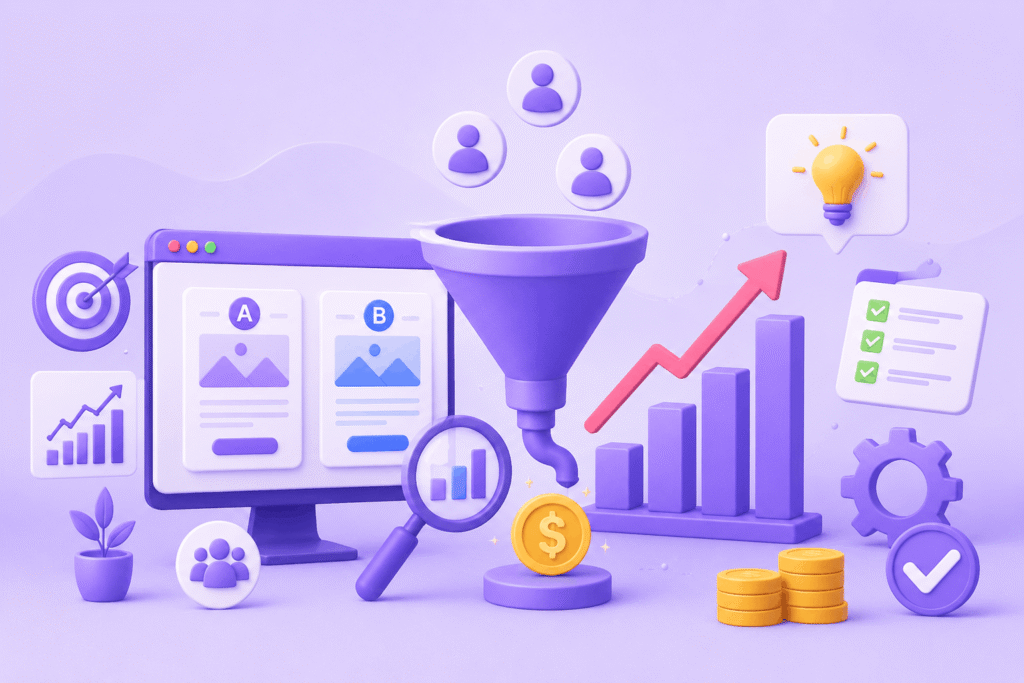
Conversion Rate Optimization (CRO) goes beyond A/B testing. It entails understanding your customers, removing obstacles, and making the entire journey of converting visitors to customers better continually. If you’re starting, or you want to do more growth activities, a final CRO checklist can be a great time saver, reduce worries, and help achieve reliable results.
Below is the full and very actionable CRO checklist for newbies and growth marketers which we will walk you through in this post. We’ll take CRO Forge as a sample tool.
1. Define Success and KPIs
First, figure out what success is for you before doing any changes to get better results on your site.
- Choose the main conversion actions (purchases, sign-ups, etc.)
- Pick measurable KPIs (conversion rate, bounce rate, avg. order value)
- Ensure that the goals reflect the overall business objectives (revenue, lead generation, retention)
Without clear goals even the best experiments would be of little significance.
2. Learn About Your Audience
CRO will work well only with knowing your users very well.
- Collect demographic and behavioral data of users.
- Identify what problems customers are looking to solve and factors that entice them for a purchase.
- Get to know your users through surveys, comment fields, and videotaping of sessions.
Follow customer paths on different devices.
Knowing your target group needs and behavior will allow you to make the most suitable changes to your site.
3. Audit Your Website or Landing Page
Performing a complete audit is the best way to discover where the visitor experience is hampered.
- Verify the website’s loading speed and optimization level.
- Check how the site behaves on a mobile device.
- Analyze the menu and overall site operation.
- Locate broken links and other technical errors.
Slow or disoriented sites may lead straight to no conversions!
4. Optimize Above-the-Fold Content
It is the very moment that a first time user lands that counts the most in creating impressions.
- Have a headline that is not only clear but also very appealing.
- Increase or reinforce your value proposition
- Make sure the CTA is immediately visible without having to scroll
- Avoid distracting elements and unnecessary information
It is essential that within a few seconds the user comprehends what you offer and why it is of value to him/her.
5. Improve Call-to-Actions (CTAs)
CTA is the conversion point.
- Choose words that inspire action (e.g. “Join Now, ” “Access Free”)
- Highlight your button with visuals
- Try out different color, font sizes, and placement
- Facilitate the user from reaching the CTA (less form fields, streamlined steps)
Even small CTA changes can significantly boost conversions.
6. Build Trust and Credibility
Trust is one of the leading causes of conversions.
- Provide customer reviews and testimonials
- Display client logos or case studies
- Add trust seals (security, payment, certifications)
- Offer easily accessible contact details
Conversion rate increases when users trust a brand.
7. Employ Data and Analytics
CRO without data is only a lottery ticket.
- Analyze user behavior with analytics software
- Measure conversion funnels
- Spot drop-off points
- Take advantage of heatmaps and session recordings
With tools such as CRO Forge, you get a clear picture and can take effective actions based on the actual user data.
8. Perform A/B Tests Wisely
Testing forms the backbone of CRO.
- Work on the most frequently visited webpages first (landing, product, home pages)
- Test just one thing at a time
- Keep tests long enough for reliable statistics
- Note findings and lessons learned
Random testing is not advisable; concentrate on theories derived from data.
9. Customize User Experience
Personalization leads to better conversion rates.
- Present content that matches the user’s behavior
- Employ geolocation targeting
- Differentiated offers for new vs returning users
- Audience segmentation to achieve better targeting
People convert more when they get a personalized experience.
10. Consider Mobile Users
Mobile traffic outweighs desktop traffic these days.
- Adapt to responsive design
- Offer simplified navigation for small screens
- Use “thumb-friendly” calls to action
- Improve loading time for mobile network
If your website is quite unpleasant on mobile, you are probably losing a big chunk of conversion.
11. Leverage the Best CRO Tools
The right tools are a game changer.
With platforms such as CRO Forge, you can:
- Conduct A/B tests with no complications
- Inspect user behavior with the help of actionable insights
- Deliver optimized experiences over websites, eCommerce, and SaaS
- Make data-driven decisions with assurance
Regardless of whether you are just getting started or a professional marketing specialist, having an efficient, yet simple-to-use, CRO platform results in faster output.
Final Thoughts
Conversion rate optimization is a perfect mix of data, psychology, and experimentation. Implementing this comprehensive checklist will help you methodically discover new areas for improvement, test changes, and raise your conversion rate without depending on guessing.
Begin with small steps, remain constant, and put first the user-value that you can deliver. Gradually, the effects of these optimizations will build up to a substantial increase in growth.
For those who want to break down the CRO process into easier steps and get more out of it, tools like CRO Forge may serve as a bridge from having insights to producing high-impact outcomes.