Operating a SaaS business involves more than just attracting clicks to your website. The real difficulty lies in acquiring users from visitors and engaging them with your brand over time. As most SaaS companies heavily rely on marketing, they will still be able to achieve much higher growth even without increasing their ad spend by getting just a little better at converting and retaining customers. That’s the beauty of A/B testing.
If done the right way, testing enables SaaS businesses to only implement what works based on actual data rather than guesswork. Whether it’s sign-up forms, pricing, onboarding, and feature adoption the whole customer journey can be improved by analyzing user behavior. Using tools such as CRO Forge startups, marketers, agencies, and other SaaS businesses can access these features to get more results with less effort.
What is A/B Testing in SaaS?
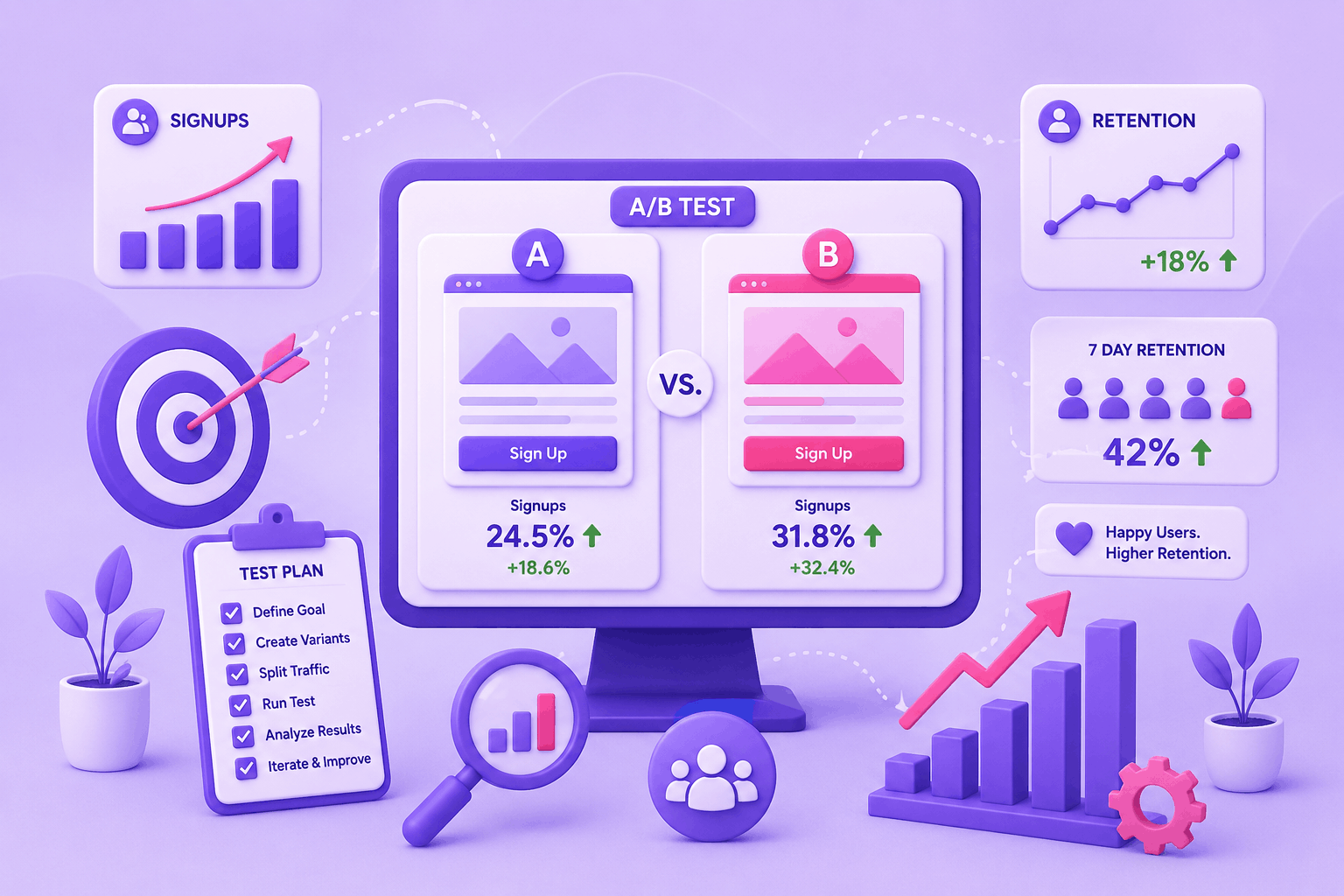
A/B testing normally involves taking two different variants of one web page/app screen/feature and finding out which is the better performer.
Take a look at our example below:
- Version A: “Start Free Trial” button
- Version B: “Get Started Free” button
Dividing the traffic randomly between two variants, you are able to find out through metrics which one leads to more clicks, sign-ups, or conversions.
Why A/B Testing Matters for SaaS Companies
Unlike traditional ecommerce sites, SaaS businesses have a different mode of operation. The customer journey is longer and retention is equally important as customer acquisition.
A visitor can:
- Check out your landing page
- Register for a free trial
- See the details of your product
- Make a payment plan subscription
- Be a monthly user of the product
If users get lost at any step, growth dependent upon user base will slow down.
A/B testing is a method of determining by:
- Reasons users do not sign up
- Reasons free trial users do not become paying customers
- Reasons why customers stop using the product
- Discovery of which features make the user more engaged
- Identification of what messaging builds trust
By getting your signup rate or retention just a little higher, your monthly recurring revenue (MRR) can go up significantly.
Important SaaS Metrics to Track During A/B Testing
An important step in the experiment process is to set the goals first. Below highlights some of the key SaaS metrics.
- Signup Conversion Rate: This metric tells you how many people that visit your site end up signing up or starting a trial.
- Free Trial to Paid Conversion: This is the counter of how many free users get converted to be paying customers.
- Customer Retention Rate: The more the customers stick around and use the service/product, the better the retention is.
- Churn Rate: The churn rate counts how many users cancel their subscriptions.
- Feature Adoption: This one is a good indicator of how often users use the most important product features.
- Customer Lifetime Value (CLV): CLV is a metric for forecasting the revenue the customer will generate for the business. It is good for identifying the result of the marketers’ budget.
When you have an integrated environment like CRO Forge in place, you can easily assess the pre-defined success metrics while simultaneously running different versions throughout the SaaS conversion funnel.
Best A/B Testing Ideas for SaaS Websites
Optimize Your Homepage Messaging
Most of the time, your homepage is going to be the first stop for a user to check out what you are about. If your messaging is not very clear, then the visitors might just leave without even thinking about browsing further.
- Headline testing
- Subhead testing
- CTA button text testing
- Hero images testing
- Product screenshots testing
- Social proof positioning testing
Example: “Project Management Software” vs “Manage Projects Faster With Your Team in One Place” Simple wording changes can improve clarity and increase conversions.
Test Your Signup Forms
It’s reported that clients often get less inclined to complete their purchases when they have to travel through long signup interfaces. It is recommendable to try:
- Form of short vs long
- Options of social login
- Multi-step forms
- Passwordless signup
- Different CTA labels
There is a lot of evidence that suggests a lot of SaaS businesses increase their signup rates by removing the extra fields that are not necessary.
Improve Pricing Pages
The pricing page is one of the most vital parts that need SaaS optimization. Check:
- Monthly vs annual visibility pricing
- Highlighted marked plans
- Layouts of the pricing table
- Feature comparison designs
- CTA button placements
- Trust badges and guarantees
Frequently a minor visual shift can greatly increase the conversion rate of paid users.
Optimize Free Trial Experiences
Getting users to start a free trial is only half the battle. The onboarding experience determines whether they stay. Check:
- Welcome screens
- Product tours
- Onboarding emails
- Interactive walkthroughs
- Progress indicators
- Setup checklists
Having a more intuitive and seamless onboarding process can go a long way in improving not only activation rates but also decreasing churn.
Test In-App User Engagement
Retention is the lifeblood of a successful SaaS company. A/B testing inside your application allows you to test various engagement features. Such as:
- Dashboard layouts
- Notification timing
- Feature discovery prompts
- Upgrade prompts
- User education content
When users quickly experience value, they are more likely to continue using the product.
Reduce Churn With Behavioral Testing
Many SaaS companies focus only on acquisition, but retention often has a bigger impact on profitability. You can test:
- Cancellation flow messaging
- Exit-intent offers
- Re-engagement emails
- Personalized recommendations
- Renewal reminders
Understanding why users leave can help improve long-term retention.
What A/B Testing Mistakes Do SaaS Companies Commonly Make?
Simultaneously Changing Too Many Elements During Testing
Making multiple changes in a single test can cloud your understanding of which change led to the effect. You should limit your focus to one main variable during each experiment.
Prematurely Ending A/B Tests
Some companies terminate tests right after seeing initial positive outcomes. Then, they may have made decisions based on the results from a limited sample; ultimately, this can lead to incorrect conclusions. Experiments need a sufficient amount of visitors and data before their results can be deemed reliable.
Disregarding Different User Segments
Since users differ, their behaviors will follow suit. For example, new versus returning visitors, enterprise customers versus startups may all respond differently to the same user experience. Audience segmentation is key to gaining deeper insights.
Choosing Vanity Metrics
Even though click-through rates may be high, they might not necessarily be leading to your growing your business in a significant way. You should center your efforts on those metrics that are directly related to your revenue as well as your customer retention rather than on mere engagement numbers.
Ways in Which CRO Forge Can Help SaaS Companies Do Experiments More Effectively
One of the primary purposes of CRO Forge is to assist businesses in their efforts to conduct A/B testing and optimization of conversions effectively without requiring them to possess complex technical skills.
SaaS firms are able to work with CRO Forge in order to:
- Easily set up and run A/B testing
- Look at actual user behaviors
- Turn landing pages and signup processes into conversion machines
- Enhance user onboarding strategies
- Boost free trial to paid conversions
- Implement data-driven changes that reduce churn
CRO Forge equips users with the necessary instruments to make wise optimization choices whether you are a startup validating your product-market fit or a mature SaaS brand that is growing through scaling.
Summary
Running A/B tests is a great tactic for SaaS companies aiming to improve signups, engagement and lower churn rate. Instead of making assumptions about user needs, testing lets you uncover user behavior and continue enhancing the product experience. The top SaaS businesses are not necessarily the ones with the largest budgets. Usually, they are the ones that continually optimize each step in the customer journey.