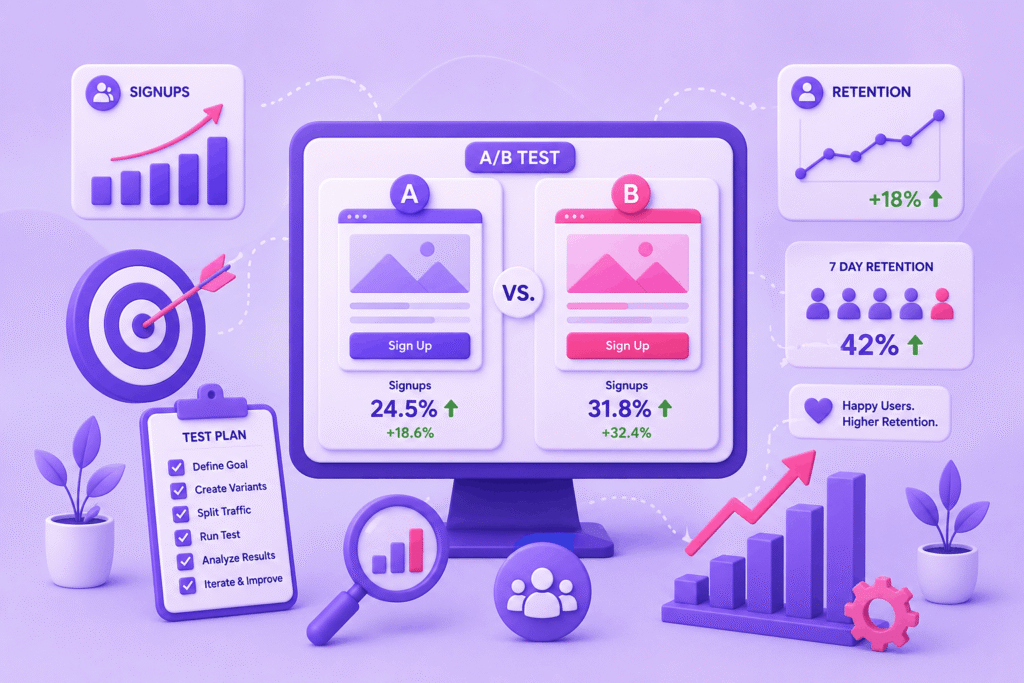
One of the methods that experts recommend as a sure way to boost your conversion rate is using A/B testing. The truth, however, is that only a few businesses have managed to see the desired outcome from their tests. Instead, most of them have ended up doing nothing, waiting for the test results in a few weeks’ time. No winning variant, no valuable insights, and no direct impact on revenue.
If you can relate to what I am saying, then you are part of the majority. Well, most A/B tests fail, not because of the idea of A/B testing, but because they are not done well.
The following are the main reasons why most people find themselves in this situation.
The Causes of the Failure of Most A/B Tests
1. Conducting Tests Without Having a Clear Hypothesis
One of the biggest mistakes is to start the tests without any justification. Changing the button colors, headings, or even the layout randomly is not going to take you far. Without any hypothesis, it is essentially a wild guess, not optimization.
A weak test example:”Switching from blue to green button.”
A strong hypothesis example:”Rewording the CTA to emphasize action will lead to higher click-through rates as users tend to respond to urgency.”
2. Not Enough Traffic or Sample Size
A/B testing needs a certain level of data in order to draw accurate results. If your website is not getting enough traffic, then you might not draw accurate results. The other problem comes when one stops a test too early. What might be a winner today might not be a winner tomorrow.
3. Making too Many Changes in a Single Test
By changing multiple elements at the same time, you will not be able to figure out what actually drove the improvement. Was it the headline? Or the image? The CTA? This will result in your tests being almost useless for informing future optimization.
4. Overlooking Statistical Significance
A lot of marketers stop their testing based on their intuition rather than digital proof. If your tests haven’t been able to achieve statistical significance, it is not advisable to consider the results reliable.
5. Focusing on the Wrong Metrics
It’s not just that there are many metrics to choose from but most of them are not useful at all. If an A/B test is showing an increase in click-through rates, but at the same time showing a decrease in conversions or revenue, then that is a failure. If you’re optimizing for vanity metrics, not business metrics, then you’re going in the wrong direction.
6. Poor User Experience Understanding
A/B testing is not just about numbers; it’s about people. If you don’t know what’s going on in your users’ heads, then you won’t know what problems you should be solving.
7. Lack of Structured Testing Process
Many teams perform A/B tests at random, which is not good. If you do not have a testing roadmap, your tests are going to be chaotic, not impactful.
How to Fix Your A/B Testing Strategy
1. Start with Data, Not Assumptions
Using user behavior analytics through tools such as heatmaps, session recordings, and other analytics is essential before making your test.
Examples of such questions:
- At what points are users leaving your site?
- What elements are causing the visitors to hesitate?
- Which pages are doing well and have the most potential for improvement?
This will make sure you are testing based on data rather than assumptions.
2. Build Strong Hypotheses
Each test must be guided by a hypothesis which should contain:
- The element that you want to change
- The reason why you want to change it
- The expected outcome
This makes the whole testing process more meaningful and more goal directed.
3. Test One Variable at a Time
It’s best if your tests remain simple and focused. It is advisable to test one main element per test so that you will easily be able to figure out what is affecting the results. In case you would want to test multiple elements, you should conduct sequential tests or go for multivariate testing if that is suitable.
4. Run Tests Long Enough
- You need to be patient because patience is always rewarded.
- Allow your tests to run until you have highly reliable results and sufficient data.
- Don’t quit your tests prematurely, not even if the results are promising.
5. Focus on Meaningful Metrics
Make sure that your tests are helping in achieving your business goals:
- Conversion rate
- Visitor revenue
- Average order value
- Lead quality
Do not allow yourself to be influenced by superficial metrics that will have no effect on your business growth.
6. Understand Your Users Deeply
Integrate quantitative data with qualitative data:
- User feedback
- Surveys
- Customer interviews
Greater insight into your users leads to more effective testing.
7. Create a Testing Roadmap
Instead of doing random tests, one should plan a roadmap:
- Prioritize pages with a big impact
- Focus on important conversion funnels
- Keep a testing backlog
This will ensure consistency and growth.
How CRO Forge Helps You Succeed
By partnering with CRO Forge to run your A/B tests, you will get access to all the tools required to convert testing into business results.
CRO Forge can help you:
- Implement tests efficiently without technical complexity
- Monitor your progress with current data
- Get data-driven insights with ease and certainty
- Improve user experiences on websites, eCommerce, and SaaS applications
You don’t have to rely on guesses, but focus on what really matters with ease.
Final Thoughts
It is not the case that A/B testing is the cause of failure, you simply have to do it the right way. The most common failed tests were those which were not well planned, lacking data, or had ambiguous goals. Yet, with a well-executed A/B test, you can leverage a growth strategy like no other. Try to keep things simple, gradual in progress, and focus on learning. In the sphere of CRO, every single test, success or failure, takes you a little bit closer to improved results.