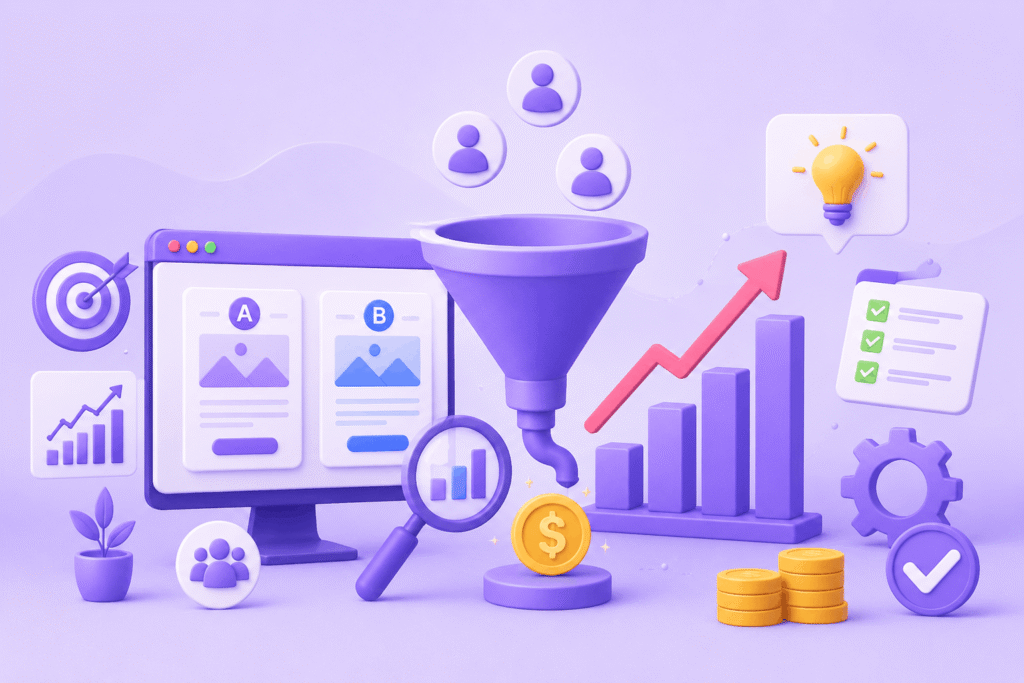
Most companies wish to increase the number of visitors to their websites, however, mere traffic is not a reliable indicator of growth. A very large number of visitors can enter a site every month, but only a handful amongst them initiate the desired action. Conversion Rate Optimization (CRO) is the solution to this problem.
However, quite a number of businesses are not able to harvest the actual benefits of CRO because they believe in several myths that sound plausible but are actually false. These wrong notions are responsible for making businesses make poor decisions, spending their marketing budgets inefficiently and losing opportunities for transforming visitors to customers. Even if your business is a running store or SaaS platform or agency, or service type, it is your knowledge of what CRO is that has the potential to change your growth path drastically.
Therefore, the following are broken down for you the top CRO myths that may be holding your business back and what you should do instead.
Myth 1: Higher number of website visitors will come with more sales
This one is, by far, the worst misunderstanding in digital marketing. Due to the belief that simply by attracting more traffic, their revenue issues will be resolved, a lot of companies end up making large investments in SEO, paid ads, and social media campaigns. Besides the fact that attracting visitors is part of the game, traffic alone doesn’t bring in the sales.
Now take the 10,000 visitors that have now made their way onto your site and suppose that they currently have a 1% conversion rate. What if you have increased their conversion rate up to 3% – and you haven’t actually done anything to your current level of traffic. You see, 10,000 visitors and a 1% conversion rate only converts 100 leads, while a 3% conversion rate converts 300! In that case you will have, in effect, tripled your customers although you have been running the same marketing campaign.
- Instead of a question like “Where do I get more visitors from?“
- You should be asking “What strategies can I adopt to convert more of my current visitors into customers?“
Myth 2: If People aren’t buying because they don’t want to!
Lots of companies mistake low conversion rates for a lack of demand. However, quite often visitors abandon a website when something “puts them off”.
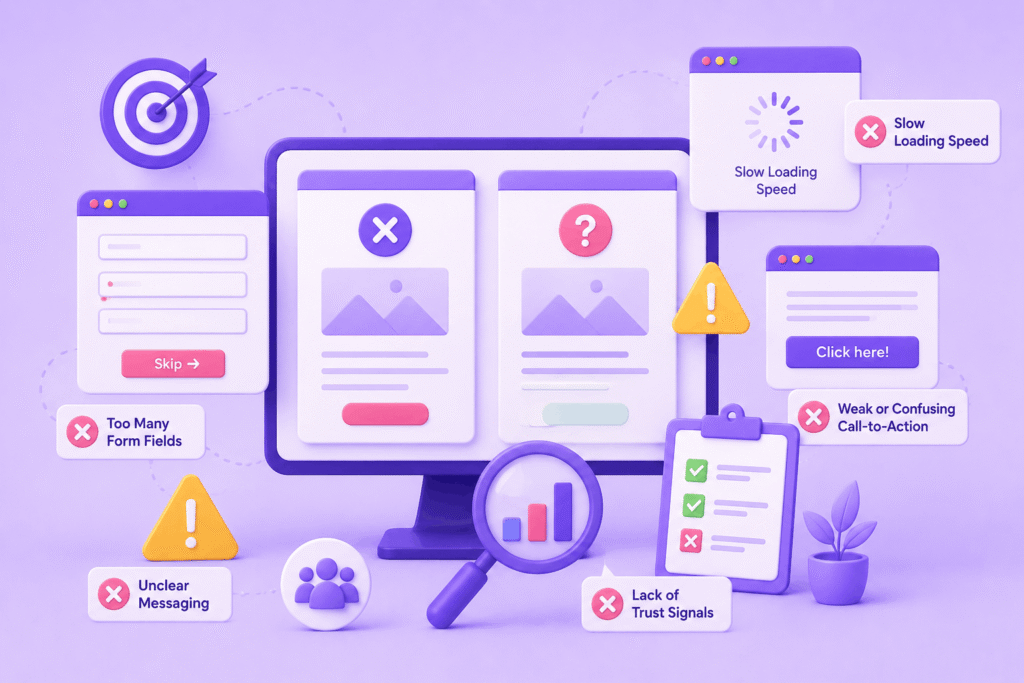
Some common things that will “put people off” are:
- Pages taking a long time to load
- Having to go through a very long or complicated checkout process
- Navigation that is confusing or hard to find what you are looking for
- No signs of credibility or authority (customer testimonials, money back guarantee, security logos and stamps of approval, etc.).
- Poor mobile experience
- Price is unclear
- Product descriptions not compelling or engaging
In fact, people could be very interested in your product but they would still hesitate if they are not completely reassured that buying it is the right thing to do. That’s why CRO is very important as it can help unveil those secret deterrents before you go on investing an increasing amount of money in traffic acquisition.
Myth 3: CRO Is Only for Large Companies
A lot of small businesses think that CRO is an extremely high-volume traffic game, that expensive software is needed and that a team dedicated only to optimization is a must. It simply is not the case. Actually smaller businesses tend to benefit more quickly because they have fewer hurdles to implementing changes. Even low volumes of traffic can give very useful insights especially if you complement them with analysis of user behavior, heatmaps, session recordings, and well thought out A/B tests.
Whatever you have going on:
- An e-commerce site
- A SaaS company
- A local store
- A blog site
- A marketing firm
Conversion rate optimization (CRO) can be a great help in boosting your performance outcomes. Simply put: The sooner you start with optimization, the less you’ll have to worry about it later!
Myth 4: One Successful Test Solves Everything
So, some of the companies out there just carry out one single A/B experiment, get a green signal from the test result, and close up shop on what’s supposed to be their optimization efforts. But
- Consumer habits vary all the time
- The arrival of new competitors
- The change of end-user expectations
- The diversification of available devices
- The transformation of marketing channels
- The thing that is effective right now probably won’t be the same as in six months’ time.
Businesses at the top of their game look at CRO as an ongoing activity rather than a one-off project, and testing non-stop is what drives both ends of the vector upward profits and growth.
Myth 5: You Should Copy What Competitors Are Doing
If you have seen a particular homepage structure, a pricing page or a style for CTAs that they use, your instinct is likely going to be to copy their actions. This would be a rational thought because you would assume that if it’s being used by your competitor, it has to be something that works. However, their audience may not even be yours. Besides, their traffic sources, customer intent, pricing strategy, and brand positioning could be completely different. Rather than copying competitors, run tests on your own ideas with your own data. Your users will always give better answers than the website of someone else.
Myth 6: More Features Mean Better Conversions
It’s a pretty common mistake for businesses to think that adding extra popups, animations, banners, offers, widgets, and forms will be great enough to entice the visitors to proceed to conversion. What is more, it is a fact that in most cases the very contrary occurs.
- Too many elements compete for attention.
- Visitors freak out.
- Picking a thing to do just gets more and more difficult.
- The successful conversion rate optimization method is not about throwing more stuff in.
It is based on cutting down the irrelevant elements and leading the user to take that one desired action that is crystal clear. Typically, simple experiences tend to do better than complicated ones.
Myth 7: CRO Is Only About Increasing Sales
It’s true that sales matter a lot. Still, they are not the only measurement of success.
An effective CRO plan can lead to:
- Obtaining leads
- Scheduling demonstrations
- Signing up for newsletters
- Registering for a trial period
- Getting customers involved
- Keeping users coming
- Being happy with the product
By making significant changes to the user experience based on your CRO efforts, you will be setting the stage to grow your business over time. Satisfied users turn into loyal customers.
How CRO Forge Helps You Optimize Your Website
Doing an excellent job of optimizing your website does not translate to making a change here or there and hoping those changes lead to a better website. On the contrary, optimization is entirely about decision-making that is grounded in the actual real user behavior of your website visitors.
CRO Forge assists companies of all sizes in implementing this strategy with ease. The software can serve those who run their own websites as well as marketing agencies that optimize websites for their clients. The platform helps you set up the A/B tests, interpret the results, uncover visitor behaviors, validate your assumptions and then proceed to implement the changes. Instead of hoping that your decisions pay off, you could find out exactly what’s most engaging to your users and continue to build on the basis of the actual data.
Final Thoughts
The biggest hurdle when it comes to growth is not always the product, price, or the marketing budget of your business. On the contrary, it can be the stumbling block of following the wrong advice. Conversion Rate Optimization is not about taking shortcuts or finding sneaky design ways. Instead, it is a well-organized series of activities including visitor comprehension, friction identification, testing of the changes, and finally, making even better decisions based on evidence.
The companies that develop regularly are not always those that are the loudest changers rather, they are the smartest changers. In case you want to enhance your conversions and at the same time not spend more on acquiring visitors, then why don’t you start by doubting some of these common myths about CRO? With that, exchange assumptions with tests, keep opinions aside and go for data, and replace mere guesses with concrete results. And that is how growth that can be sustained long-term really happens.