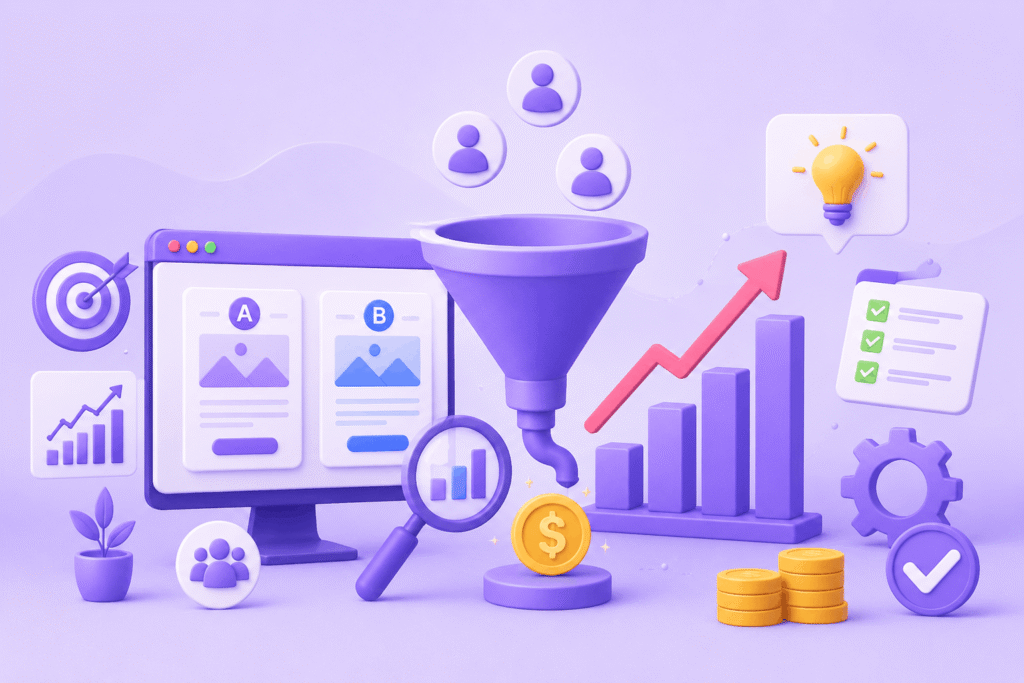
Even if you succeed in getting visitors to your eCommerce website in the highly competitive market, this is only a half victory. The greater difficulty is in converting these visitors into buyers. At this point Conversion Rate Optimization (CRO) can actually be the key. CRO aims at enhancing your site so that an increased number of visitors perform the desired actions, for example, purchasing a product, subscribing to a mailing list, or placing items in the shopping cart.
For eCommerce companies, a slight increase in the conversion rate is able to dramatically raise income without additional marketing costs. Understanding customer behavior, experimenting with new concepts, and improving the main features of your shop will all contribute to a more pleasant and convincing shopping journey. The likes of CRO Forge can be of immense help in offering sophisticated A/B testing and CRO tools that enable companies to base their decisions on data, instead of guesswork.
Hereby, we provide you with some effective CRO strategies that eCommerce websites can use to enhance user experience.
Optimize Your Website Speed
Page speed is another major factor in conversion. E-commerce customers expect fast page loading. A page loading slowly by a few seconds is enough for people to lose interest in your site.
Ways to enhance website speed:
- Compress images and switch to modern image formats.
- Remove script and plugin usage that is not essential.
- Choose a hosting provider that is dependable and a CDN that is well-distributed.
- Turn on browser caching.
The pleasure of use goes up at a faster site, and bounce rates fall. At the same time there are more visits and more interactions with customers.
Use High-Quality Product Images and Videos
Your buyers do not have the chance to touch the products physically, so pictures and videos become extremely influential. Trust is established through good quality images and videos disclosure and customers gain a better understanding of the product.
- Displaying various pictures illustrating the product from different sides.
- Offering the ability to zoom in for a closer inspection of the item.
- Making available short videos that explain how the product works.
- Demonstrating the product in a real life situation.
Compelling visuals can be a game changer when it comes to purchase decisions and product abandonment.
Simplify the Checkout Process
A complicated checkout process is one of the top factors for abandoning shopping carts. Customers may lose interest in making a purchase if they find it difficult to understand the checkout process.
Ways to enhance checkout:
- Lead customers through the purchase by minimizing the number of steps.
- Make checkout possible as a guest.
- Use auto-filling of customer details wherever feasible.
- Enable customers multiple payment methods.
An efficient checkout process facilitates customers’ purchase completion in no time.
Build Trust with Social Proof
Trust plays a major role in decisions made by customers online. It is highly likely for customers to purchase from a website that displays genuine reviews from other buyers.
Methods of adding social proof:
- Text-based and star-scored feedback from customers.
- Satisfied customer testimonials.
- Customer-created content such as pictures or video.
- Trust badges and icons for secured payments.
Displaying real social proof can raise trust and mitigate the fear of buying.
Improve Your Call-to-Action (CTA)
Buttons with a call-to-action instruct users on the steps to take next in a purchase. Quality CTA design can lead to a great increase in sales.
Examples of good CTA:
- Direct and action shots like “Buy Now” or “Add to Cart”.
- Contrasting the button with the rest of the page.
- Putting CTA buttons in places where users’ eyes naturally go.
- Trying different colors, sizes, and phrases.
Tools like CRO Forge enable you to test various versions of CTA and identify the one that gets the highest conversion rate.
Personalize the Shopping Experience
Personalization takes shopping experiences to another level of relevance for customers. When customers are presented with products and promotions that match their preferences, it is natural for them to buy.
Personalization can be done through:
- Recommendations of products based on one’s own browsing and shopping history.
- Giving customers special prices or deals.
- Having a homepage that is updated with the latest and most suitable content for users.
- Sending desirable emails to remind customers about the cart that they had left behind.
With these actions, customers are able to connect with a brand that understands and treats them as individuals. This is a prime reason why these customers convert more often.
Optimize your website for mobile users
Most eCommerce traffic nowadays comes through mobile devices. If your site isn’t mobile-friendly, you’ll be losing potentially a lot of customers.
Some mobile optimization pointers:
- Use responsive layouts.
- Make sure that the buttons are large enough to tap easily.
- Make the navigation more straightforward for smaller screens.
- Compress your images and tailor your content to load quickly on mobile devices.
Offering a smooth mobile experience will let shoppers comfortably look through and buy products from any device.
Implement A/B testing for data-driven decision making
Constant experimentation is one of the best CRO tactics. Rather than making a rough guess about the best option, A/B testing gives you a chance to juxtapose two versions of an element and find out which one brings better results.
You can perform A/B tests on:
- Headlines and product information.
- CTA buttons.
- Website designs.
- Pricing options.
- Pictures of the products.
CRO Forge has a simple A/B testing tool that you can use to try out new ideas for your business, company, or even marketing agency. By using real user data, you will be in a position to make decisions that are likely to produce a high conversion rate for your business.
Minimize cart abandonment
Cart abandonment is one of the biggest challenges facing online retailers. There are a number of people who add items to their virtual shopping carts but end up leaving without completing the purchase.
To tackle abandonment:
- Make shipping fees visible from the beginning.
- Give a choice of payment methods.
- Present exit-intent proposals or price cuts.
- Forgotten cart reminder emails.
Fixing these problems might result in recovering lost revenue and an increase in overall conversion rates.
Employ heatmaps to interpret visitor behavior
Understanding how your website is being used could be very beneficial to your optimization efforts. Heatmaps show you where visitors click, scroll, and spend most of their time.
With this data, you can:
- Find the parts of your pages that visitors ignore.
- Elevate your site’s visual appeal and organization.
- Hang up your signs where the foot traffic is heaviest.
- Get rid of the things that distract and result in converting less.
Heatmaps along with A/B testing can prove to be a powerful combination for unveiling continuous enhancements to your webpage that yield higher performances.
Conclusion
Conversion Rate Optimization is an essential ingredient for eCommerce businesses looking to leverage their online sales to the fullest. Focusing on user experience, the buying process, trust, and experimenting with various approaches are just some of the ways to make a drastic change in your conversion rates.
The key to the success of CRO lies in making informed decisions based on data, unlike making assumptions or guesses. Businesses can easily conduct experiments, analyze the results, and make changes to enhance their online sales with the help of CRO Forge.
Whether you’re running a small online store or handling large eCommerce campaigns, the implementation of these CRO approaches might help you convert more visitors into loyal customers and increase your revenue in the long run.